Table of Contents
Introduction
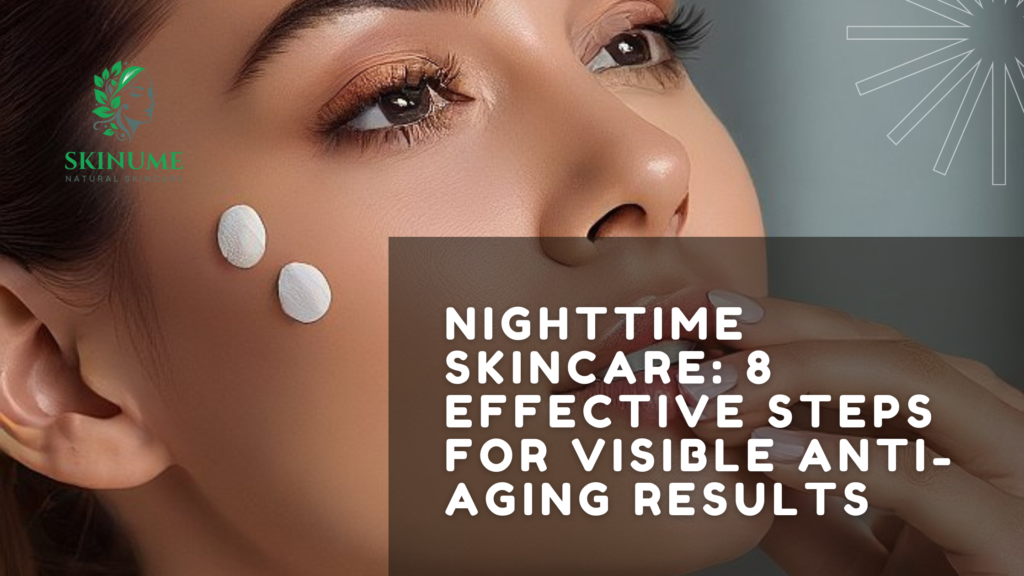
It is your skin that is performing the most essential of its labor at this time when you are asleep–it must be in accordance with your practice. Nighttime skincare is not merely about washing off your face after putting makeup on and having a cleansing session, but it is all about giving your skin what it needs to aid in healing, rejuvenating and fighting the aging effects your face shows. Your skin has more active ingredients, produces more collagen and cell turnover is higher at night.

In other words, what you put on your skin and apply to your body right before you go to sleep may significantly impact how your skin will be smooth, hard, or shiny in the long term. The difference between dullness and weariness of the skin, and healthful, glowing glow, may be a very large one, and it may be your nightly habits and amusements.
The Importance of Nighttime Skincare
It is not sleeping that you rest your skin when you sleep but it is going to work. The body floods with blood to the skin at night and its natural healing is taking place. This is when the damaged cells are repaired, and new ones are created; that is why Nighttime Skincare is needed to possess younger, healthier skin.
There is also an increased rate of cell turnover during the night, i.e., it sheds dead skin and regenerates better. It helps not only to reduce dullness and flattening of fine lines, but also improves the texture of your skin- but only provided your skin is properly taken care of before going to bed.
Another main advantage of night practices is an improvement in absorption. Your skin is dealt in a more favorable state to take in the active elements and chemicals like Retinol, peptides, and the moisturizing elements without being subjected to sunlight, pollution or even make-up. This makes your night products very effective in comparison to daytime products.
Conversely, not taking good care of yourself at night is also a fast track towards accelerated aging. Washing your face, applying a moisturizer or not using makeup can lead to blocked pores, dehydration, and degeneration of collagen in the long-run. Night Skincare is not merely an indulgence; it will become an investment in your skin over your lifetime.
Step 1. Cleaning (Doubling up) to make a Clean Canvas
The initial ingredient of any successful use of Nighttime Skincare Products is a clean face. During the day your skin accumulates makeup, sunscreen, excess oils, dirt and pollutants of the environment. A single wash often cannot be able to remove all these layers and that is why twice cleaning may be so effective.
Start with an oil cleanser which will aid in dissolving makeup, SPF and sebum. Oil is an oil-hugging lover, so it is very effective in removing impurities that would be so hard to extract without leaving your skin behind. Use a water-based cleaner to remove any sweat, dirt or other matter that may be left behind and feel clean and refreshed.
Special care will prevent arteriovenous obstructions, an eruption and dimness. Nor does it leave your products, on which you apply afterwards, with diminished penetration and functionality. Such omission can not only reduce the effectiveness of your entire routine, no matter how good the quality of your products is.
Step 2. Use a Gently Exfoliator (2-3 times a Week)
Exfoliation is a great procedure followed by a Nighttime Skincare, done rightfully it becomes effective. It removes the dead cells of the skin that might be deposited on the surface, making the skin rough and uneven with fine lines in the skin.
Exfoliators can be divided into two types: chemical and physical. The exfoliants are chemical (AHAs and BHAs) which dissolve the dead cells, and tend to be more effective and not as abrasive. Physical exfoliants are tiny particles that are rubbed on the skin manually without having to be abrasive, as they may irritate the skin.
Normal exfoliation can lead to a reduction of the texture of the skin, and smoother and brighter skin and can increase the uptake of serums and moisturizers. It could however lead to destruction of the skin barrier by overshedding in your skin which will result in reduced skin that is red, tender and dry. A weekly or twice its good idea in order to experience the observable anti-aging outcomes.
Step 3. Addhydrating Toner to form a Balance
Having cleaned and exfoliated, you need to rebalance and prepare your skin and in this respect, a moisturizing toner is needed. Toner replenishes the normal pH levels of your skin and cleansing of the skin disturbs the normal level.
Toner is applied in a nighttime skincare routine since it is employed between cleansing and treatment. It can help in enhanced intake of serums and moisturizers on your skin, which will consequently allow other procedures of your routine to be effective.
Find those ingredients that can attract and retain water on the skin such as hyaluronic acid and glycerin. These ingredients of the liquidifiers help to inflate the skin, reduce the appearance of wrinkles and create a coarse board upon which the next actions will be made. The toners that contain harsh alcohols should never be used because then they will all go to waste; they will practically dry your skin, undoing your anti-aging process.
Check Out: Winter Skincare: How to Protect and Nourish Your Skin in Harsh Cold.
Step 4. Concentrate on Concerns with Serums

Serums would be missing in the nighttime skincare routine. They contain no creams; unlike them contain very active ingredients, which reach deeper into the skin, and address the concerns of the individual areas, such as fine lines, dullness or loss of firmness.
Some of the established ingredients that you would be targeting in recipes that strive to replicate the similarity of the anti-aging properties comprise retinol (to hasten cell turnover and collagen), peptides (to preserve skin structure), and vitamin C in anti-aging recipes that do not lighten the skin on a person (to brighten and repair). They all perform different functions and therefore, the right serum to purchase will be dependent on what your skin requires.
The principle of layering should be done according to the thinnest to thickest texture, the bottom-most texture. Use a solution based on water and then use the heavier ones. All actives- retinol, strong acids, etc.- should not be used together in a certain routine unless your skin is adjusted to them mixed. The long-term application of the right serum would mean a skin that would be even smoother and firmer.
Step 5. Eye Cream is Reduced
Skin around the eyes or even underneath is also the thinnest and the most sensitive to the aging process, as compared to the rest of your face and hence you will find that the close area of your eyes is the first part to reflect the aging process. The initial spots to develop these fine lines, swollenness and black circles and, hence, eye care is one of the essential steps of Nighttime Skincare.
A specially designed eye cream will also help in shaping up the skin, fine lines and the decreased puffiness. The swelling can be minimized using caffeine and others, peptides and hyaluronic acid can be used to improve firmness and hydration.
Another dimension of application that will be important as the product will be matter. Using your small portion of the ring finger, tap around the orbital bone–DO NOT rub/pull on the skin. This light tension is advantageous to prevent unnecessary tension, and to keep the sensitive part of an individual under a youthful appearance.
Step 6. Bind the Moisture with the help of a Night Cream
The particular creams, night creams, are designed to help in repairing the skin when the individual is asleep. They are more likely to be rich and stuffed with moisturizers that are hydrating and anti-aging as opposed to moisturizers that are applied during the day.
Night skincare routine is also a great night cream that will replenish the skin, and create barriers that help in the skin and skin collagen production.
Membrane: Applying a night cream on the last (or just before applying oils) layer is also helpful; seal all the layers with this, where feasible.
Step 7. Add Face Oils in order to have extra Nourishment
Other ingredients could be facial oils, especially ahead of going to bed, since it is your Nighttime Skincare routine. Not essential, but could enhance the degree of hydration and give your skin a smooth, healthy look.
Use oils at the same time your moisturizer is on, as it will seal and trap a lot of moisture. You hardly need much–stuff them into your flesh and don’t scratch.
Oils like olefusia rosehip and argan are considered to be the best oils as far as anti-aging factors are concerned. Essential fatty acids and vitamin A present in rosehip oil contribute to plate tectonic action, which restores the skin, whereas argan oil enhances the skin with regard to its skin elasticity and smoothness. Without being sticky and greasy, facial oils are put to the best use; they can be used to make your day a lot fancier.
Step 8. Lululemon Overnight Treatments/Masks

The treatment is to be done overnight since this is the time when your skin is at its highest level of repair. The products not only substitute the normal moisturizers, but also prevent extreme hydration and active things by providing night-long protection.
Examples are the sleeping masks, which create a protective layer that traps the moisture and enhances absorption of ingredients. They are generally used after a few times a week when you feel like changing your night cream or as per the needs of your skin.
To include photos in your Nighttime Skincare routine, one of the methods is to apply a weekly treatment to infuse some light into your face and add some elasticity and quick visible changes. Whether it is a water-quenching mask or some sort of anti-aging regimen, with these additions, you will notice physically the morning of how fresh and glowing your skin is going to appear.
Conclusion
A Part of the Nighttime Skincare habit is one of the most effective in achieving an apparent anti-aging effect without making your day-to-day activities more hectic. So, just as a good cleaning is good, or some treatments (or even a good sleep), see how each small step would make your skin repair and renew while you are asleep and get stronger.
It should not be what the most expensive products should be used and what the latest trends to follow, but taking proper measures towards your skin and sticking to them. With time, these 8 steps can be applied to relieve aging effects, improve texture and other features of the skin and restore youthful and healthy luster to the skin.
Suppose your scenario night is a long-term investment. Whatever you get yourself to do to-day to create how your skin will look and feel tomorrow, will come to pass.
For more info: Click Here.
FAQs
1. Does it mean that I need not use skincare at night if I am too tired?
Once in a while will surely not impact your skin but an accustomed practice of this style will make the outcome less quick. At least, clean your face and put on some moisturizer to avoid the dirt and oil buildup and keep your face intact.
2. Can one apply retinol on a nighttime basis?
This will rely on what kind of skin you have and the resolution. Beginners are to begin with 2-3 times per week, and ensure that they gradually increase their frequency.